The 2026 Industrial NPI Sourcing Playbook: From BOM Lock to Production Ramp

Matthieu Benat
•

The 2026 Industrial NPI Sourcing Playbook: From BOM Lock to Production Ramp
Matthieu Benat
•
The 2026 Industrial NPI Sourcing Playbook: From BOM Lock to Production Ramp
Matthieu Benat
•
Introduction
TL;DR: Up to 80% of product cost is locked in before procurement sees a single part number. This playbook gives you a 6-phase NPI sourcing framework from BOM receipt to production ramp to fix that, along with a free downloadable supplier qualification checklist.
Industrial teams have long treated procurement as a downstream function something that kicks in after engineers finalize the design, lock the BOM, and hand it over. The cost of that model is well documented: up to 80% of product cost is determined at the design stage, before procurement has been consulted on a single component. Add that roughly 30% of NPI delays trace back to sourcing issues discovered only after BOM freeze, and you have a reliable recipe for expensive fire drills at every product launch.
The 2026 environment makes this worse. Tariff volatility, supply chain fragmentation, and nearshoring pressure have all compressed the window for sourcing decisions. The teams that win product launches move procurement left into the design phase and run a repeatable, data-driven NPI sourcing process on every program.
This playbook gives you exactly that: a 6-phase framework, a compressed timeline benchmark, and a downloadable supplier qualification checklist.
What Is NPI sourcing and why is it different?
New Product Introduction sourcing is the process of identifying, qualifying, and contracting suppliers for a product that doesn't yet exist in production. Unlike steady-state procurement replenishing known parts from approved suppliers at negotiated prices NPI starts with a blank slate. No approved vendor list. No historical spend data. Decisions are engineering-led, timelines are compressed, and the cost of a wrong call compounds as the program matures.
Three archetypes define the range of approaches. Reactive procurement enters after BOM freeze and optimizes within constraints it had no hand in defining. Collaborative procurement engages at prototype stage, with enough visibility to flag high-risk parts before the design is fully locked. Proactive procurement enters at the design phase, feeding sourcing cost signals back to engineering in real time where the real leverage lives.
The gap between reactive and proactive is a process gap. The 6-phase framework below is designed to close it.
The Cost Lock-In Problem
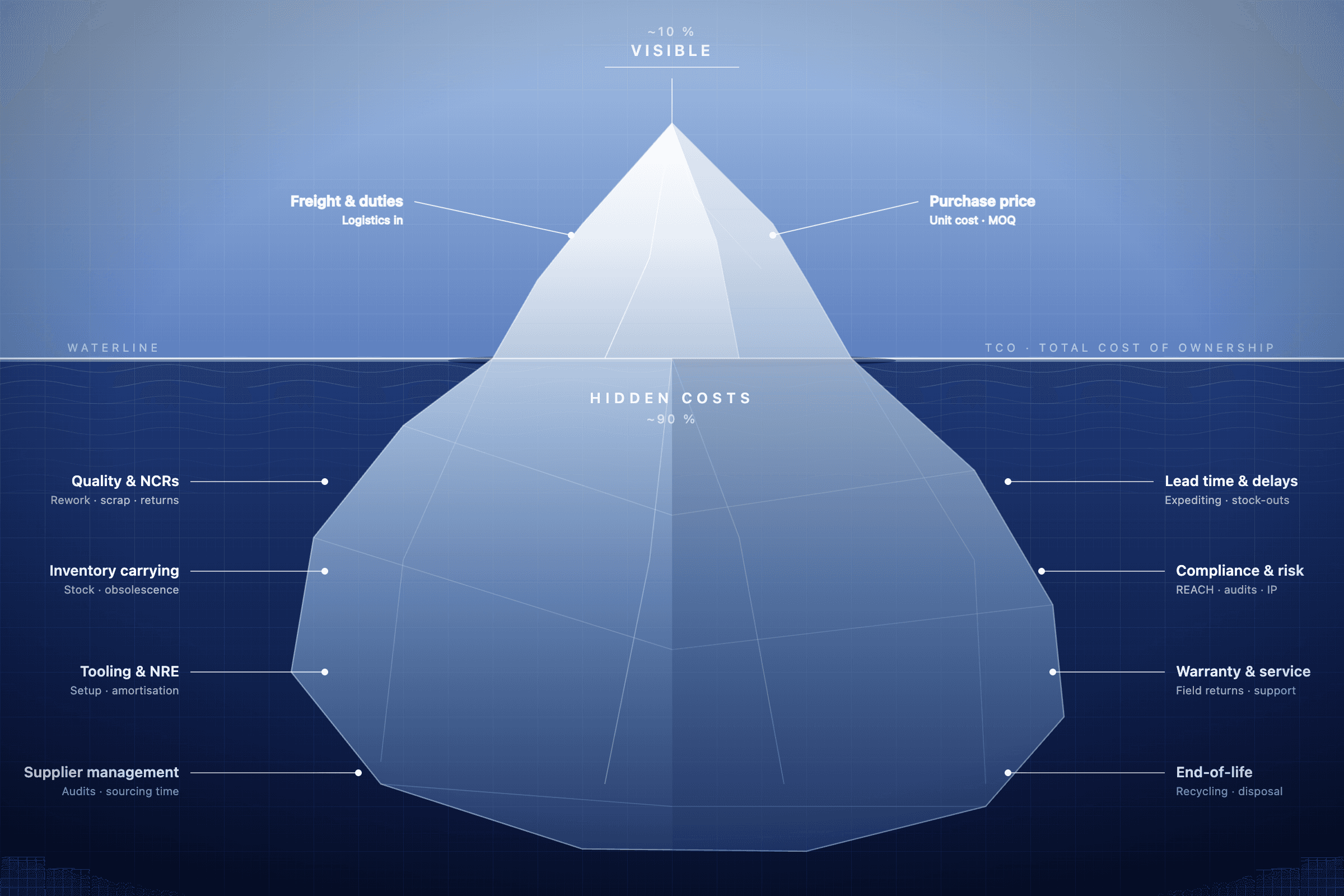
The cost commitment curve describes a simple but uncomfortable truth: the further a product advances through development, the less opportunity there is to influence its cost. By the time a BOM is frozen and handed to buyers, material choices, supplier pools, and component tolerances have already been made and their cost implications are locked in.
The downstream tax shows up in three predictable ways: constrained supplier pools drive premium pricing with no competitive pressure; single-source dependencies create production ramp risk that surfaces at the worst moment; and spec mismatches trigger BOM re-spins that cost time and engineering cycles.
Standard enterprise platforms (Coupa, SAP Ariba, Ivalua) weren't built for this. They excel at managing spend across established categories with known suppliers. Faster quoting inside these tools doesn't fix a structural process problem. Earlier, BOM-native engagement does.
The 6-Phase Industrial NPI Sourcing Framework
Phase 1 — BOM Receipt & Part Classification
Every NPI engagement begins with the engineering BOM. The first task is understanding what you're working with before issuing a single RFQ. Classify parts into four buckets: standard/commodity, custom/engineered, long-lead, and sole-sourced. This produces a sourcing risk map a part-level view of program exposure before anyone has made a call.
Key output: Sourcing risk map by part number.
Phase 2 — Supplier Identification & Pre-Qualification
Map existing approved vendor relationships against BOM requirements and identify the gaps. For uncovered categories, run pre-qualification against consistent criteria: quality certifications (ISO 9001, IATF 16949, AS9100), manufacturing capacity, geographic footprint, and financial stability. Target a shortlist of 2–3 pre-qualified suppliers per critical part. Dual-sourcing from this stage is the cheapest insurance available in NPI — supplier gaps found at production ramp cost orders of magnitude more to resolve.
Key output: Shortlist of 2–3 pre-qualified suppliers per critical part.
Phase 3 — RFQ Execution & Quote Normalization
Issue RFQs in parallel across the shortlist not sequentially. Parallel execution compresses the quoting cycle and creates real competitive pressure. Then normalize every quote: unit price, tooling cost, MOQ, payment terms, lead time, tariff classification, and landed cost. In a tariff-heavy environment, a supplier quoting aggressively from a tariff-exposed geography may be less competitive in total cost terms than a higher-priced supplier closer to your production site.
Key output: Normalized quote comparison matrix.
Phase 4 — Cost-to-Design Feedback Loop
This is where proactive procurement earns its keep. Before design freeze, feed sourcing cost signals back to engineering. The normalized quote matrix isn't just a procurement deliverable it's a design input. Engineers can then make informed trade-offs: relaxing a tolerance that opens the supplier pool, approving a substitute component with better market availability, or enabling dual-source on a currently sole-sourced part. A formal Design for Sourcing (DFS) review gate scheduled before freeze is the mechanism.
Key output: DFS recommendations report shared with engineering before design freeze.
Phase 5 — Prototype & Pilot Sourcing
Source prototype quantities from the Phase 2 shortlist and use this stage to stress-test supplier relationships. How does a supplier respond when a spec is unclear? What does their quality documentation look like on arrival? Document performance systematically on-time delivery, quality conformance, responsiveness, corrective action speed. This data is the primary input to production supplier selection in Phase 6.
Key output: Prototype supplier scorecard per critical part.
Phase 6 — Production Ramp & Supplier Lock-In
Convert prototype performance data and commercial negotiations into a confirmed, documented supplier base. For each critical part, confirm production-intent status, negotiate volume pricing and blanket PO terms, and agree on safety stock commitments. Complete formal supplier qualification (PPAP, First Article Inspection, or equivalent) before production volumes are committed. The Approved Supplier List (ASL) that exits this phase becomes the foundation of steady-state procurement.
Key output: Approved Supplier List (ASL) for production, with qualification records by part.
NPI Sourcing Timeline: Legacy vs. 2026
The traditional NPI sourcing timeline is sequential and slow each phase waiting for the previous to close. The result: 12–24 month cycles that compress margins and delay revenue.
The 2026 benchmark is 8–12 weeks. The acceleration levers are clear: automated BOM ingestion eliminates manual data entry; parallel RFQs collapse the quoting timeline; AI-assisted supplier matching surfaces qualified options in hours; real-time tariff monitoring prevents Phase 3 surprises.
But speed exposes weak data foundations. When sourcing cycles shrink, the bottleneck shifts from process to data quality. Teams that want to move fast need clean, structured supplier data certifications, capacity, geography, financial indicators available at BOM ingestion, not assembled reactively during qualification.
The 5 Most Common NPI Sourcing Pitfalls
Procurement brought in too late. The most common and most expensive mistake. Establish a formal trigger for procurement engagement at the start of product development, not at the end.
Single-source dependencies discovered at production ramp. Dual-source qualification from Phase 2 onward is the only reliable mitigation.
Quote normalization skipped. Raw price comparisons are misleading. Teams that skip normalization routinely pick the supplier who looks cheapest on quote and proves most expensive in practice.
No cost-to-design feedback loop. Sourcing data that stays inside procurement is wasted leverage. A formal DFS review gate is the highest-ROI process change available in NPI.
Supplier qualification skipped at prototype stage. The shortcut is paid for at production ramp, when capability gaps surface under volume pressure for the first time.
How AI Is Changing Industrial NPI Sourcing in 2026
The traditional NPI sourcing workflow is manual and fragmented — BOM exported to a spreadsheet, supplier contacts sourced from personal networks, RFQ emails drafted individually, quotes compared in yet another spreadsheet. Every step introduces delay and error.
AI-native sourcing platforms are automating the most time-consuming parts of this workflow: BOM ingestion in minutes rather than hours, supplier discovery from structured databases matched by category, certification, and geography, and RFQ generation triggered automatically at BOM receipt. The most meaningful shift is in the Phase 4 feedback loop when AI can normalize quotes, flag tariff exposure, and surface dual-source options in real time, the DFS conversation becomes data-driven rather than intuition-driven.
At Siembra, we built our platform specifically for this challenge: BOM-native AI agents that speak the language of part numbers, specifications, and certifications not generic spend categories compressing the path from BOM receipt to qualified supplier shortlist without sacrificing qualification rigor.
NPI Supplier Qualification Checklist
Download our free NPI Supplier Qualification Checklist — used by industrial procurement teams to qualify suppliers faster and reduce production ramp risk.
What's inside:
40-point qualification checklist (certifications, capacity, quality, financials, logistics)
Part-level risk scoring template
Prototype supplier scorecard template
Go/no-go decision framework for production lock-in
Stop discovering supplier gaps at production ramp. Qualify in advance.
Conclusion
The cost lock-in problem isn't going away. As long as engineering leads design without procurement visibility, most product cost will be determined before procurement can influence it. The only sustainable fix is structural: move procurement left, build a repeatable process, and run it the same way on every program.
The teams that systematize NPI sourcing ship faster, at lower BOM cost, and with fewer production ramp surprises. Your next launch is the opportunity to run the process right. Start with Phase 1.
Introduction
TL;DR: Up to 80% of product cost is locked in before procurement sees a single part number. This playbook gives you a 6-phase NPI sourcing framework from BOM receipt to production ramp to fix that, along with a free downloadable supplier qualification checklist.
Industrial teams have long treated procurement as a downstream function something that kicks in after engineers finalize the design, lock the BOM, and hand it over. The cost of that model is well documented: up to 80% of product cost is determined at the design stage, before procurement has been consulted on a single component. Add that roughly 30% of NPI delays trace back to sourcing issues discovered only after BOM freeze, and you have a reliable recipe for expensive fire drills at every product launch.
The 2026 environment makes this worse. Tariff volatility, supply chain fragmentation, and nearshoring pressure have all compressed the window for sourcing decisions. The teams that win product launches move procurement left into the design phase and run a repeatable, data-driven NPI sourcing process on every program.
This playbook gives you exactly that: a 6-phase framework, a compressed timeline benchmark, and a downloadable supplier qualification checklist.
What Is NPI sourcing and why is it different?
New Product Introduction sourcing is the process of identifying, qualifying, and contracting suppliers for a product that doesn't yet exist in production. Unlike steady-state procurement replenishing known parts from approved suppliers at negotiated prices NPI starts with a blank slate. No approved vendor list. No historical spend data. Decisions are engineering-led, timelines are compressed, and the cost of a wrong call compounds as the program matures.
Three archetypes define the range of approaches. Reactive procurement enters after BOM freeze and optimizes within constraints it had no hand in defining. Collaborative procurement engages at prototype stage, with enough visibility to flag high-risk parts before the design is fully locked. Proactive procurement enters at the design phase, feeding sourcing cost signals back to engineering in real time where the real leverage lives.
The gap between reactive and proactive is a process gap. The 6-phase framework below is designed to close it.
The Cost Lock-In Problem
The cost commitment curve describes a simple but uncomfortable truth: the further a product advances through development, the less opportunity there is to influence its cost. By the time a BOM is frozen and handed to buyers, material choices, supplier pools, and component tolerances have already been made and their cost implications are locked in.
The downstream tax shows up in three predictable ways: constrained supplier pools drive premium pricing with no competitive pressure; single-source dependencies create production ramp risk that surfaces at the worst moment; and spec mismatches trigger BOM re-spins that cost time and engineering cycles.
Standard enterprise platforms (Coupa, SAP Ariba, Ivalua) weren't built for this. They excel at managing spend across established categories with known suppliers. Faster quoting inside these tools doesn't fix a structural process problem. Earlier, BOM-native engagement does.
The 6-Phase Industrial NPI Sourcing Framework
Phase 1 — BOM Receipt & Part Classification
Every NPI engagement begins with the engineering BOM. The first task is understanding what you're working with before issuing a single RFQ. Classify parts into four buckets: standard/commodity, custom/engineered, long-lead, and sole-sourced. This produces a sourcing risk map a part-level view of program exposure before anyone has made a call.
Key output: Sourcing risk map by part number.
Phase 2 — Supplier Identification & Pre-Qualification
Map existing approved vendor relationships against BOM requirements and identify the gaps. For uncovered categories, run pre-qualification against consistent criteria: quality certifications (ISO 9001, IATF 16949, AS9100), manufacturing capacity, geographic footprint, and financial stability. Target a shortlist of 2–3 pre-qualified suppliers per critical part. Dual-sourcing from this stage is the cheapest insurance available in NPI — supplier gaps found at production ramp cost orders of magnitude more to resolve.
Key output: Shortlist of 2–3 pre-qualified suppliers per critical part.
Phase 3 — RFQ Execution & Quote Normalization
Issue RFQs in parallel across the shortlist not sequentially. Parallel execution compresses the quoting cycle and creates real competitive pressure. Then normalize every quote: unit price, tooling cost, MOQ, payment terms, lead time, tariff classification, and landed cost. In a tariff-heavy environment, a supplier quoting aggressively from a tariff-exposed geography may be less competitive in total cost terms than a higher-priced supplier closer to your production site.
Key output: Normalized quote comparison matrix.
Phase 4 — Cost-to-Design Feedback Loop
This is where proactive procurement earns its keep. Before design freeze, feed sourcing cost signals back to engineering. The normalized quote matrix isn't just a procurement deliverable it's a design input. Engineers can then make informed trade-offs: relaxing a tolerance that opens the supplier pool, approving a substitute component with better market availability, or enabling dual-source on a currently sole-sourced part. A formal Design for Sourcing (DFS) review gate scheduled before freeze is the mechanism.
Key output: DFS recommendations report shared with engineering before design freeze.
Phase 5 — Prototype & Pilot Sourcing
Source prototype quantities from the Phase 2 shortlist and use this stage to stress-test supplier relationships. How does a supplier respond when a spec is unclear? What does their quality documentation look like on arrival? Document performance systematically on-time delivery, quality conformance, responsiveness, corrective action speed. This data is the primary input to production supplier selection in Phase 6.
Key output: Prototype supplier scorecard per critical part.
Phase 6 — Production Ramp & Supplier Lock-In
Convert prototype performance data and commercial negotiations into a confirmed, documented supplier base. For each critical part, confirm production-intent status, negotiate volume pricing and blanket PO terms, and agree on safety stock commitments. Complete formal supplier qualification (PPAP, First Article Inspection, or equivalent) before production volumes are committed. The Approved Supplier List (ASL) that exits this phase becomes the foundation of steady-state procurement.
Key output: Approved Supplier List (ASL) for production, with qualification records by part.
NPI Sourcing Timeline: Legacy vs. 2026
The traditional NPI sourcing timeline is sequential and slow each phase waiting for the previous to close. The result: 12–24 month cycles that compress margins and delay revenue.
The 2026 benchmark is 8–12 weeks. The acceleration levers are clear: automated BOM ingestion eliminates manual data entry; parallel RFQs collapse the quoting timeline; AI-assisted supplier matching surfaces qualified options in hours; real-time tariff monitoring prevents Phase 3 surprises.
But speed exposes weak data foundations. When sourcing cycles shrink, the bottleneck shifts from process to data quality. Teams that want to move fast need clean, structured supplier data certifications, capacity, geography, financial indicators available at BOM ingestion, not assembled reactively during qualification.
The 5 Most Common NPI Sourcing Pitfalls
Procurement brought in too late. The most common and most expensive mistake. Establish a formal trigger for procurement engagement at the start of product development, not at the end.
Single-source dependencies discovered at production ramp. Dual-source qualification from Phase 2 onward is the only reliable mitigation.
Quote normalization skipped. Raw price comparisons are misleading. Teams that skip normalization routinely pick the supplier who looks cheapest on quote and proves most expensive in practice.
No cost-to-design feedback loop. Sourcing data that stays inside procurement is wasted leverage. A formal DFS review gate is the highest-ROI process change available in NPI.
Supplier qualification skipped at prototype stage. The shortcut is paid for at production ramp, when capability gaps surface under volume pressure for the first time.
How AI Is Changing Industrial NPI Sourcing in 2026
The traditional NPI sourcing workflow is manual and fragmented — BOM exported to a spreadsheet, supplier contacts sourced from personal networks, RFQ emails drafted individually, quotes compared in yet another spreadsheet. Every step introduces delay and error.
AI-native sourcing platforms are automating the most time-consuming parts of this workflow: BOM ingestion in minutes rather than hours, supplier discovery from structured databases matched by category, certification, and geography, and RFQ generation triggered automatically at BOM receipt. The most meaningful shift is in the Phase 4 feedback loop when AI can normalize quotes, flag tariff exposure, and surface dual-source options in real time, the DFS conversation becomes data-driven rather than intuition-driven.
At Siembra, we built our platform specifically for this challenge: BOM-native AI agents that speak the language of part numbers, specifications, and certifications not generic spend categories compressing the path from BOM receipt to qualified supplier shortlist without sacrificing qualification rigor.
NPI Supplier Qualification Checklist
Download our free NPI Supplier Qualification Checklist — used by industrial procurement teams to qualify suppliers faster and reduce production ramp risk.
What's inside:
40-point qualification checklist (certifications, capacity, quality, financials, logistics)
Part-level risk scoring template
Prototype supplier scorecard template
Go/no-go decision framework for production lock-in
Stop discovering supplier gaps at production ramp. Qualify in advance.
Conclusion
The cost lock-in problem isn't going away. As long as engineering leads design without procurement visibility, most product cost will be determined before procurement can influence it. The only sustainable fix is structural: move procurement left, build a repeatable process, and run it the same way on every program.
The teams that systematize NPI sourcing ship faster, at lower BOM cost, and with fewer production ramp surprises. Your next launch is the opportunity to run the process right. Start with Phase 1.
Introduction
TL;DR: Up to 80% of product cost is locked in before procurement sees a single part number. This playbook gives you a 6-phase NPI sourcing framework from BOM receipt to production ramp to fix that, along with a free downloadable supplier qualification checklist.
Industrial teams have long treated procurement as a downstream function something that kicks in after engineers finalize the design, lock the BOM, and hand it over. The cost of that model is well documented: up to 80% of product cost is determined at the design stage, before procurement has been consulted on a single component. Add that roughly 30% of NPI delays trace back to sourcing issues discovered only after BOM freeze, and you have a reliable recipe for expensive fire drills at every product launch.
The 2026 environment makes this worse. Tariff volatility, supply chain fragmentation, and nearshoring pressure have all compressed the window for sourcing decisions. The teams that win product launches move procurement left into the design phase and run a repeatable, data-driven NPI sourcing process on every program.
This playbook gives you exactly that: a 6-phase framework, a compressed timeline benchmark, and a downloadable supplier qualification checklist.
What Is NPI sourcing and why is it different?
New Product Introduction sourcing is the process of identifying, qualifying, and contracting suppliers for a product that doesn't yet exist in production. Unlike steady-state procurement replenishing known parts from approved suppliers at negotiated prices NPI starts with a blank slate. No approved vendor list. No historical spend data. Decisions are engineering-led, timelines are compressed, and the cost of a wrong call compounds as the program matures.
Three archetypes define the range of approaches. Reactive procurement enters after BOM freeze and optimizes within constraints it had no hand in defining. Collaborative procurement engages at prototype stage, with enough visibility to flag high-risk parts before the design is fully locked. Proactive procurement enters at the design phase, feeding sourcing cost signals back to engineering in real time where the real leverage lives.
The gap between reactive and proactive is a process gap. The 6-phase framework below is designed to close it.
The Cost Lock-In Problem
The cost commitment curve describes a simple but uncomfortable truth: the further a product advances through development, the less opportunity there is to influence its cost. By the time a BOM is frozen and handed to buyers, material choices, supplier pools, and component tolerances have already been made and their cost implications are locked in.
The downstream tax shows up in three predictable ways: constrained supplier pools drive premium pricing with no competitive pressure; single-source dependencies create production ramp risk that surfaces at the worst moment; and spec mismatches trigger BOM re-spins that cost time and engineering cycles.
Standard enterprise platforms (Coupa, SAP Ariba, Ivalua) weren't built for this. They excel at managing spend across established categories with known suppliers. Faster quoting inside these tools doesn't fix a structural process problem. Earlier, BOM-native engagement does.
The 6-Phase Industrial NPI Sourcing Framework
Phase 1 — BOM Receipt & Part Classification
Every NPI engagement begins with the engineering BOM. The first task is understanding what you're working with before issuing a single RFQ. Classify parts into four buckets: standard/commodity, custom/engineered, long-lead, and sole-sourced. This produces a sourcing risk map a part-level view of program exposure before anyone has made a call.
Key output: Sourcing risk map by part number.
Phase 2 — Supplier Identification & Pre-Qualification
Map existing approved vendor relationships against BOM requirements and identify the gaps. For uncovered categories, run pre-qualification against consistent criteria: quality certifications (ISO 9001, IATF 16949, AS9100), manufacturing capacity, geographic footprint, and financial stability. Target a shortlist of 2–3 pre-qualified suppliers per critical part. Dual-sourcing from this stage is the cheapest insurance available in NPI — supplier gaps found at production ramp cost orders of magnitude more to resolve.
Key output: Shortlist of 2–3 pre-qualified suppliers per critical part.
Phase 3 — RFQ Execution & Quote Normalization
Issue RFQs in parallel across the shortlist not sequentially. Parallel execution compresses the quoting cycle and creates real competitive pressure. Then normalize every quote: unit price, tooling cost, MOQ, payment terms, lead time, tariff classification, and landed cost. In a tariff-heavy environment, a supplier quoting aggressively from a tariff-exposed geography may be less competitive in total cost terms than a higher-priced supplier closer to your production site.
Key output: Normalized quote comparison matrix.
Phase 4 — Cost-to-Design Feedback Loop
This is where proactive procurement earns its keep. Before design freeze, feed sourcing cost signals back to engineering. The normalized quote matrix isn't just a procurement deliverable it's a design input. Engineers can then make informed trade-offs: relaxing a tolerance that opens the supplier pool, approving a substitute component with better market availability, or enabling dual-source on a currently sole-sourced part. A formal Design for Sourcing (DFS) review gate scheduled before freeze is the mechanism.
Key output: DFS recommendations report shared with engineering before design freeze.
Phase 5 — Prototype & Pilot Sourcing
Source prototype quantities from the Phase 2 shortlist and use this stage to stress-test supplier relationships. How does a supplier respond when a spec is unclear? What does their quality documentation look like on arrival? Document performance systematically on-time delivery, quality conformance, responsiveness, corrective action speed. This data is the primary input to production supplier selection in Phase 6.
Key output: Prototype supplier scorecard per critical part.
Phase 6 — Production Ramp & Supplier Lock-In
Convert prototype performance data and commercial negotiations into a confirmed, documented supplier base. For each critical part, confirm production-intent status, negotiate volume pricing and blanket PO terms, and agree on safety stock commitments. Complete formal supplier qualification (PPAP, First Article Inspection, or equivalent) before production volumes are committed. The Approved Supplier List (ASL) that exits this phase becomes the foundation of steady-state procurement.
Key output: Approved Supplier List (ASL) for production, with qualification records by part.
NPI Sourcing Timeline: Legacy vs. 2026
The traditional NPI sourcing timeline is sequential and slow each phase waiting for the previous to close. The result: 12–24 month cycles that compress margins and delay revenue.
The 2026 benchmark is 8–12 weeks. The acceleration levers are clear: automated BOM ingestion eliminates manual data entry; parallel RFQs collapse the quoting timeline; AI-assisted supplier matching surfaces qualified options in hours; real-time tariff monitoring prevents Phase 3 surprises.
But speed exposes weak data foundations. When sourcing cycles shrink, the bottleneck shifts from process to data quality. Teams that want to move fast need clean, structured supplier data certifications, capacity, geography, financial indicators available at BOM ingestion, not assembled reactively during qualification.
The 5 Most Common NPI Sourcing Pitfalls
Procurement brought in too late. The most common and most expensive mistake. Establish a formal trigger for procurement engagement at the start of product development, not at the end.
Single-source dependencies discovered at production ramp. Dual-source qualification from Phase 2 onward is the only reliable mitigation.
Quote normalization skipped. Raw price comparisons are misleading. Teams that skip normalization routinely pick the supplier who looks cheapest on quote and proves most expensive in practice.
No cost-to-design feedback loop. Sourcing data that stays inside procurement is wasted leverage. A formal DFS review gate is the highest-ROI process change available in NPI.
Supplier qualification skipped at prototype stage. The shortcut is paid for at production ramp, when capability gaps surface under volume pressure for the first time.
How AI Is Changing Industrial NPI Sourcing in 2026
The traditional NPI sourcing workflow is manual and fragmented — BOM exported to a spreadsheet, supplier contacts sourced from personal networks, RFQ emails drafted individually, quotes compared in yet another spreadsheet. Every step introduces delay and error.
AI-native sourcing platforms are automating the most time-consuming parts of this workflow: BOM ingestion in minutes rather than hours, supplier discovery from structured databases matched by category, certification, and geography, and RFQ generation triggered automatically at BOM receipt. The most meaningful shift is in the Phase 4 feedback loop when AI can normalize quotes, flag tariff exposure, and surface dual-source options in real time, the DFS conversation becomes data-driven rather than intuition-driven.
At Siembra, we built our platform specifically for this challenge: BOM-native AI agents that speak the language of part numbers, specifications, and certifications not generic spend categories compressing the path from BOM receipt to qualified supplier shortlist without sacrificing qualification rigor.
NPI Supplier Qualification Checklist
Download our free NPI Supplier Qualification Checklist — used by industrial procurement teams to qualify suppliers faster and reduce production ramp risk.
What's inside:
40-point qualification checklist (certifications, capacity, quality, financials, logistics)
Part-level risk scoring template
Prototype supplier scorecard template
Go/no-go decision framework for production lock-in
Stop discovering supplier gaps at production ramp. Qualify in advance.
Conclusion
The cost lock-in problem isn't going away. As long as engineering leads design without procurement visibility, most product cost will be determined before procurement can influence it. The only sustainable fix is structural: move procurement left, build a repeatable process, and run it the same way on every program.
The teams that systematize NPI sourcing ship faster, at lower BOM cost, and with fewer production ramp surprises. Your next launch is the opportunity to run the process right. Start with Phase 1.